
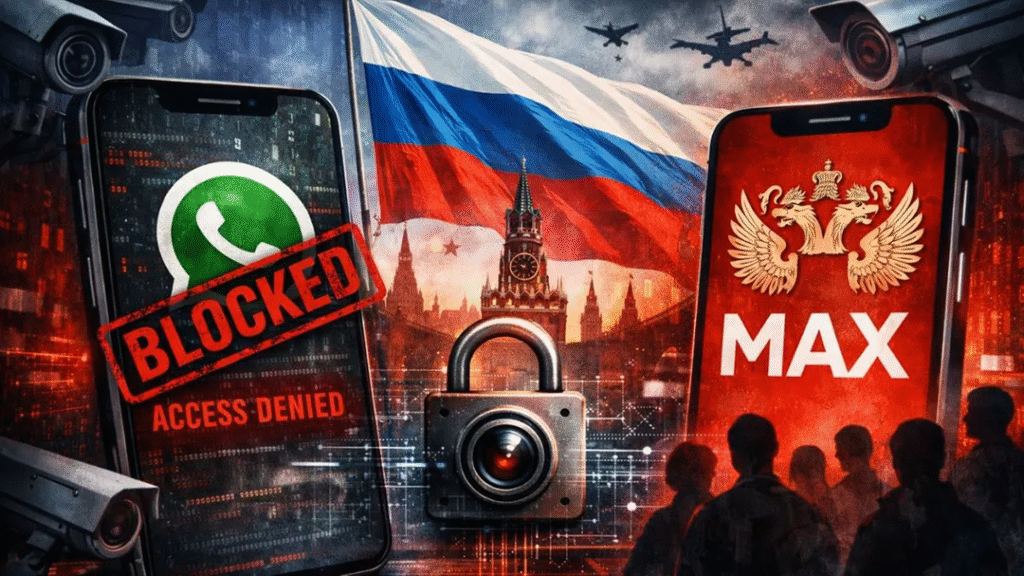
Russian authorities have escalated their campaign to limit access to foreign messaging services by ordering a block on WhatsApp, the Meta-owned platform. The move is widely seen as an effort to redirect more than 100 million Russian users toward the state-developed Max app, which critics argue could facilitate government surveillance.
Kremlin Cites Legal Non-Compliance
Kremlin spokesperson Dmitry Peskov told the BBC that WhatsApp’s block was due to the company’s “unwillingness to comply with the norms and the letter of Russian law.” He suggested that Meta could resume operations if it adhered to Russian regulations and engaged in dialogue with authorities.
When asked if the block aimed to force citizens to use Max, Peskov described it as an “available alternative” rather than a compulsory choice.
Russia has intensified its digital control strategy by launching a massive crackdown on WhatsApp, marking one of the strongest moves yet against foreign messaging platforms. The decision is widely viewed as part of a broader effort by the Kremlin to tighten its grip on online communications and steer citizens toward state-approved alternatives.
With over 100 million users in Russia, WhatsApp has long been one of the country’s most popular messaging services. However, authorities now argue that the platform has failed to comply with local data laws and security requirements. Critics, on the other hand, see the move as a major step toward expanding state surveillance and digital censorship.
Telegram Also Faces Restrictions
Russian internet regulator Roskomnadzor announced further restrictions on Telegram, citing security concerns. This decision has drawn criticism even from pro-war bloggers, who claim it hinders communication for Russian forces in Ukraine.
Push for Domestic Messaging Apps
Efforts to replace global messaging platforms with state-backed alternatives predate Russia’s 2022 full-scale invasion of Ukraine but have intensified during the conflict. Authorities have promoted the Max app through television campaigns, billboards, and official communications, while also mandating its pre-installation on all new devices sold in Russia since 2025. Public sector employees, teachers, and students are increasingly required to use the platform.

Critics argue that Max lacks end-to-end encryption, potentially allowing authorities access to private communications. The app has been compared to China’s WeChat, a “super app” which integrates messaging with government services.
WhatsApp and Meta Push Back
Meta has previously faced restrictions in Russia, with Instagram and Facebook blocked after the company was labeled an “extremist organization” in 2022. WhatsApp stressed that the block threatens private and secure communication:
“Trying to isolate over 100 million users from private and secure communication is a backwards step and can only lead to less safety for people in Russia.”
Russian authorities claim WhatsApp and Telegram have refused to store Russian users’ data locally, as required by law, and that WhatsApp is a channel for fraud and extortion.
Rise of the State-Backed Max App
At the center of this digital shift is the government-supported Max app, a domestic messaging platform that authorities are actively promoting. Since 2025, Russia has required the pre-installation of Max on all newly sold smartphones and tablets. Public sector employees, teachers, and students are increasingly expected to use it.
Critics argue that Max lacks end-to-end encryption, potentially allowing authorities access to private messages. The app has often been compared to China’s WeChat, which combines messaging, payments, and government services into a single ecosystem.
Supporters of the policy claim that a national messenger enhances digital sovereignty and reduces reliance on foreign technology companies.
Digital Rights Groups Raise Concerns
The digital rights organization Na Svyazi (In Touch) reported that 13 popular websites—including YouTube, Facebook, WhatsApp Web, Instagram, BBC, and Deutsche Welle—have been removed from the National System of Domain Names. Accessing these sites now requires the use of a VPN.
Voices from Telegram
Pavel Durov, founder of Telegram, accused the Russian state of restricting his service to push citizens toward Max for surveillance and political censorship. He compared the situation to Iran’s attempted Telegram ban, noting that citizens there found ways to bypass restrictions.
“Restricting citizens’ freedom is never the right answer,” Durov said.
As Russia continues to promote Max and restrict foreign platforms, the battle over digital freedom and secure communications in the country is far from over.
Meta’s Response and International Reaction
WhatsApp responded by emphasizing its commitment to secure communication, stating that isolating millions of users from private messaging services undermines online safety. Since Meta was designated an extremist organization in Russia in 2022, its other platforms — Facebook and Instagram — have already been blocked, accessible only via VPN services.
Digital rights groups warn that this crackdown signals a deeper fragmentation of the global internet, sometimes referred to as the “splinternet.” Organizations like Na Svyazi (In Touch) report that several major international websites have been removed from Russia’s National Domain Name System, limiting open access to information.
A Growing Digital Divide
Russia’s decision reflects a broader global trend where governments seek tighter control over digital infrastructure. By promoting domestic alternatives and restricting foreign platforms, Moscow aims to create a more controlled and self-reliant online ecosystem.
However, critics argue that such measures reduce freedom of expression, limit access to independent information, and increase the risk of surveillance.
As the crackdown unfolds, millions of Russian users face uncertainty about how they will communicate securely in the future. Whether this move strengthens national security or deepens digital isolation remains a topic of intense international debate.
FAQs
#Russia #WhatsAppBlocked #MaxApp #Carrerbook #Anslation #TelegramRestrictions #DigitalFreedom #Meta #PavelDurov #Roskomnadzor