

It is indeed a rare theatrical moment when Man and Boy returns to the London stage. Terence Rattigan’s 1963 drama has long existed in the shadow of his better-known masterpieces such as The Deep Blue Sea and Separate Tables. Its original short run and lukewarm reception during a period dominated by the rise of “angry young men” playwrights like John Osborne meant it never fully secured its place in the theatrical canon. The 2005 London revival starring David Suchet offered a fleeting reappraisal, but even that failed to cement its legacy.
Now, at the National Theatre’s Dorfman, the play resurfaces as part of Indhu Rubasingham’s inaugural programming for the space. This alone signals ambition: reviving a lesser-performed Rattigan work in a venue often associated with bold, contemporary pieces. The question hanging in the air is whether this production can finally redeem Man and Boy and restore it to serious consideration.
A Timely Tale of Power and Corruption
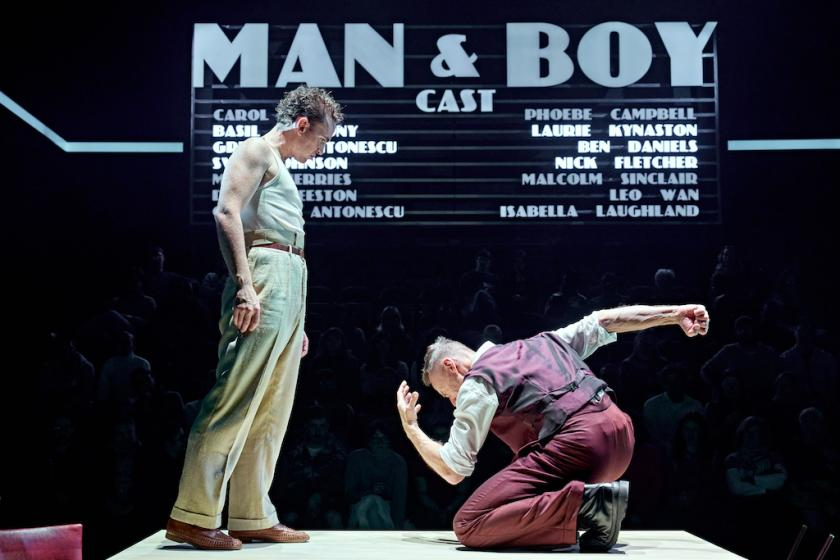
The narrative hinges on a deeply troubling premise: Antonescu attempts to use his estranged son Basil as a bargaining tool in a morally dubious deal with the secretly homosexual chairman of American Electric. On paper, the plot strains credibility. Yet under Anthony Lau’s direction, the implausibility softens, replaced by momentum and theatrical conviction.
Set in 1934, in the aftermath of the Wall Street Crash, the play dissects financial manipulation, moral compromise, and the brutal mechanics of capitalist survival. At its centre is Gregor Antonescu, a Romanian financier whose empire—built on racketeering and sharp practice—is collapsing under corruption charges.
In an era shaped by revelations of corporate misconduct and scandals echoing figures like Jeffrey Epstein, the play’s themes feel strikingly current. Abuse of power, transactional relationships, and moral decay remain disturbingly relevant.
Silver-Screen Spectacle Meets Stage Artifice
Georgia Lowe’s in-the-round set design transforms the Dorfman into something resembling both a snooker arena and a stylised 1930s film set. The green baize floor and low square lighting rig intensify the claustrophobic atmosphere. Character names illuminate art deco-style across a back wall as actors enter — a deliberate nod to cinematic credits.
This overt theatricality creates a heightened world, one where performance itself becomes part of the spectacle. A clothing rack, a piano, and a solitary telephone punctuate the otherwise sparse space. The minimalism places emphasis firmly on the actors, while the stylised staging reinforces the sense of calculated game-playing.
Aline David’s movement direction adds further flourish. Characters slide across tables in anguish, perch atop furniture to deliver impassioned speeches, and move with exaggerated physicality. At times, it resembles screwball comedy fused with financial noir — an ambitious but occasionally overwhelming blend.
Performances of Power and Fragility
Ben Daniels dominates as Antonescu in a performance of chilling authority. His portrayal is lizard-like, sleek and predatory, commanding obedience with a flick of the wrist or a measured pause.
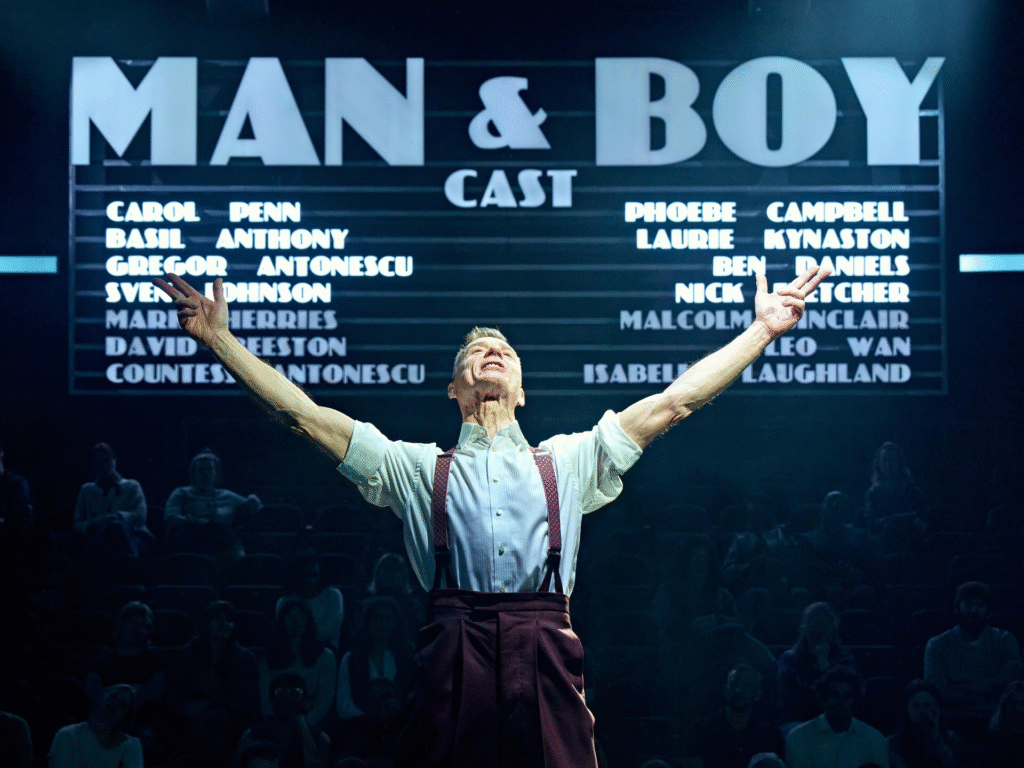
Daniels captures the ruthless hunger of a man who feeds on control. His Antonescu is not merely corrupt but psychologically dependent on dominance.
Opposite him, Laurie Kynaston’s Basil offers vulnerability and wounded idealism. His attempts to reconcile with a father who views him as a commodity are painfully sincere. Yet the stylised production sometimes distances the audience from Basil’s emotional core. His betrayal—being effectively offered as leverage in a sexual transaction—ought to devastate, but the conceptual framing occasionally dulls its impact.
Supporting performances add texture. Phoebe Campbell’s Carol leans toward caricature with an exaggerated accent, while Malcolm Sinclair’s Herries injects tension into the moral negotiations. Isabella Laughland brings theatrical flair as Antonescu’s wife, though her character risks feeling more archetype than flesh-and-blood figure.
Style Versus Substance
The production’s greatest strength is also its weakness. The bold reinvention injects energy and modern resonance into a play often accused of stiffness. However, the heightened style sometimes smothers Rattigan’s subtle emotional undercurrents.
The first half, in particular, feels weighed down by its own conceptual ambition. The operatic performances and exaggerated gestures create distance rather than intimacy. Only later, when some theatrical excess is pared back, does genuine emotional engagement begin to surface — though perhaps too late.
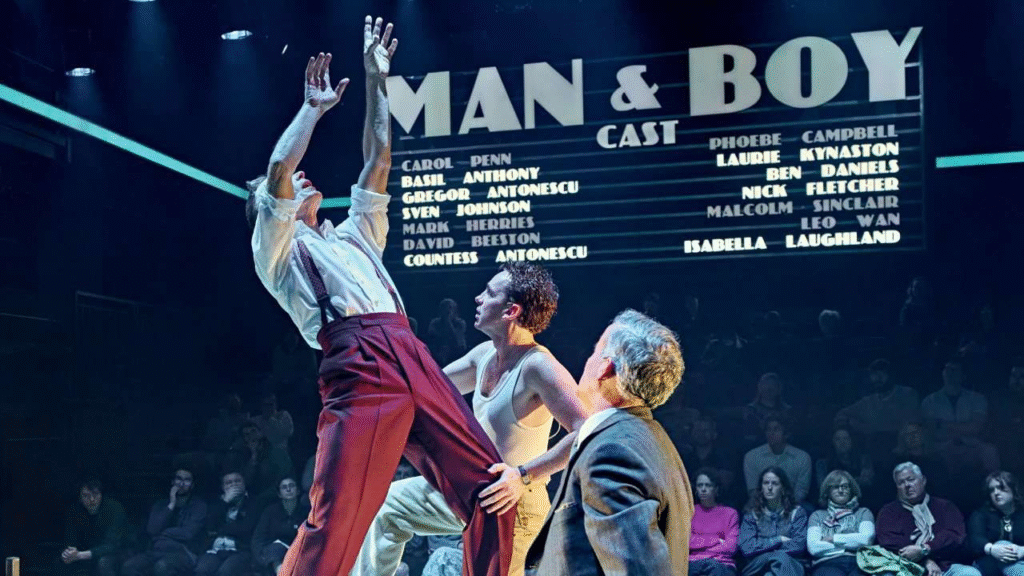
Gregor Antonescu emerges as a darker Gatsby figure: charismatic, morally bankrupt, and ultimately hollow. His rejection of filial love is intellectually understood but not always viscerally felt.
Final Thoughts
Man and Boy may still not represent Rattigan at his most humane or emotionally layered. Yet this revival presents the play in arguably its most dynamic light. Anthony Lau’s direction ensures a propulsive, visually striking evening, even if the emotional tragedy sometimes slips through the cracks of its silver-screen gloss.
The National Theatre deserves credit for daring to revisit a lesser-known work and reframing it with contemporary urgency. Whether this production secures Man and Boy a firmer foothold in the canon remains uncertain — but it undeniably reignites debate about its place.
FAQs
Disclaimer: This review reflects the author’s independent critical opinion based on a live performance of Man and Boy at the National Theatre. Interpretations of staging, performances, and thematic analysis are subjective and intended for commentary purposes only.
#ManAndBoy #TerenceRattigan #NationalTheatre #TheatreReview #LondonTheatre #StageRevival #WestEnd #BenDaniels #DramaReview #TheatreCritic #PlayReview #DorfmanTheatre #BritishTheatre #StageDrama #SilverScreenStyle#Carrerbook#Anslation.

What to Order at Starbucks: A Complete Beginner’s Guide
Walking into Starbucks for the first time can feel a bit confusing. The menu is…

San Francisco on a Budget: Affordable Travel Guide with Hidden Gems
San Francisco is often seen as one of the most expensive cities in the United…

Live Better Every Day with Simple Lifestyle Changes
In today’s fast-paced world, managing work, health, and personal life can feel overwhelming. Many people…

Unlock Your Inner Glow with Simple Beauty Tips
In today’s fast-moving world, beauty is often associated with expensive products, trending routines, and flawless…

Realme 16 5G: Everything You Need to Know Before Buying
The mid-range smartphone market in 2026 is more competitive than ever, with brands constantly introducing…

Angelina Jolie’s Iconic Black Dress Looks and How to Recreate Them
When it comes to timeless elegance and effortless sophistication, Angelina Jolie stands as one of…